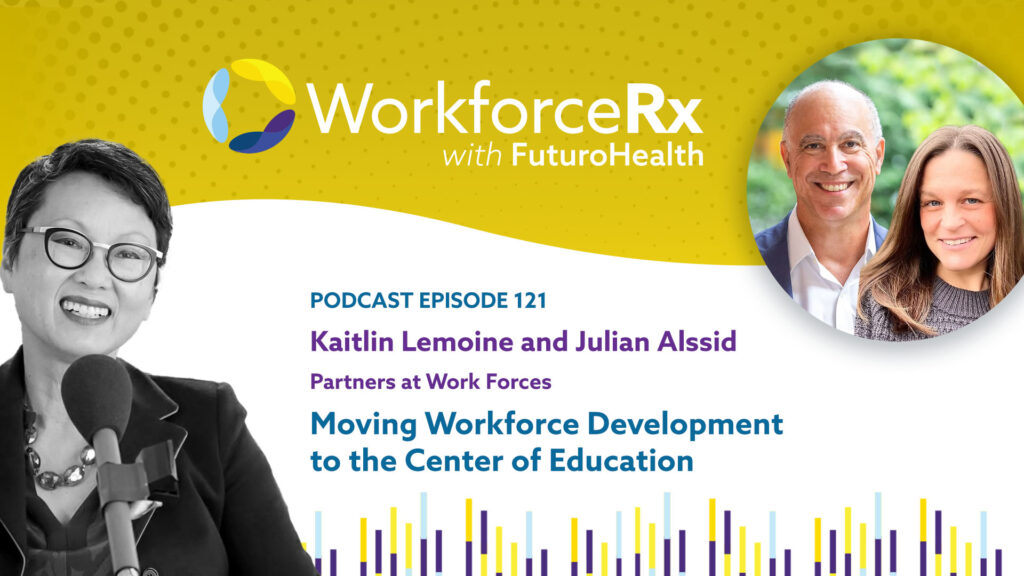
Kaitlin Lemoine and Julian Alssid, Partners At Work Forces: Moving Workforce Development to the Center of Education

PODCAST OVERVIEW
Transcript
Van Ton-Quinlivan
Hello, I’m Van Ton-Quinlivan, CEO of Futuro Health, welcoming you to WorkforceRx where I interview leaders and innovators for insights into creating a future-ready workforce.
Today, I’m happy to welcome Julian Alssid and Kaitlin LeMoine to the podcast who are both nationally recognized experts in education and workforce development. Julian and Kaitlin have combined their decades of experience in the field to create Work Forces, a consulting firm that advises C-suite leaders and organizations on bridging the gap between education and industry and optimizing for the future of work and learning.
They are also co-hosts of the bi-weekly podcast Work Forces, on which I was a recent guest — that was a lot of fun — and I’m looking forward to continuing our discussion about bringing innovation to the field.
Thanks very much for joining us today, both of you.
Julian Alssid
Thanks for having us.
Kaitlin LeMoine
Thank you so much for having us. Great to see you, Van.
Van
Absolutely. Well, what brought the two of you together to found Work Forces and how do you describe its mission? Maybe we can start with you, Kaitlin.
Kaitlin
That sounds great. Thanks, Van. It’s great to see you. We really appreciated having you on our podcast a few weeks ago, and it’s great to be with you here today. So to give a bit of background on ourselves…so Julian and I met well over a decade ago now, actually at Southern New Hampshire University where we both were working on what was a competency-based education model called College for America.
Julian was working on the more partnership and policy side of the house, and I was brought on to design curriculum for the competency-based model. We had met at that point in time and then went off on our separate paths for many years and then came back together a few years ago, realizing we had very complementary skill sets that really covered the full spectrum of partnership, policy, program, and practice and so we’re excited to bring that kind of holistic set of skills to what we now have as Work Forces.
Van
Julian, anything to add?
Julian
Yes, well first Van, thank you so much for having us. It was great to see you on our pod and we’re so thrilled to be here. Yeah, what would I add? First, Kaitlin and I really share a belief that there are sort of persistent and critical gaps between education and industry that hinder economic advancement for individuals, for the country, for the world and we founded work Worces to bridge those gaps.
The consulting we provide is really very tailored services around strategy and implementation, and basically we take on really complex assignments that allow us to leverage our expertise to address challenges that our clients just don’t have the time or capacity to do given their day jobs. This is, as you know, really hard work.
The podcast grew out of our early consulting work together. We actually went on a listening tour to hear from innovators in the field and we started turning to one another after each meeting and said, like, we really should be recording these conversations. And literally that’s how we started and it’s taken on a life of its own. We just had our 50th episode.
Van
Well, congratulations on the 50th episode! Julian, I think we first connected in your role at College for America. I’m curious how you’ve tracked the competency-based education movement and now that you have some time in the rear window, what are your thoughts on its momentum?
Julian
Yeah, well, it’s really interesting. When Kaitlin and I worked at College for America, it was an early proof of concept in the field. You know, it still holds water. I think what’s happened is people have come to realize that we need alternative ways of learning and that the notion of competency-based, project-based learning — Kaitlin can speak way more to the programmatic side of this — but it really was all about demonstrating mastery of skills and that idea has caught on.
We have other early starters, but now many, many groups are getting into the act and we think we’re gonna be seeing more and more of it. It’s still a bit upstream because that’s not what the main of academics and education is built around…they still have the traditional seat time models. But I think we’re seeing it evolve pretty quickly. I don’t know…Kaitlin, I’m actually curious to hear your take on this one.
Kaitlin
I would say I think there’s been a movement toward everything from skills-based hiring to more of an emphasis on skills when thinking about curriculum and program design and that has been really exciting to see over the last decade. I think there’s so much great momentum there, especially as we think about how to de-silo and speak more effectively across education and industry.
And I think the competency or skills-based end of that is so critical, right? Because it really gets down to what is it we’re looking for learners to know and be able to do, and articulate that really clearly. I think in industry, employers are looking for something similar. They also want to be very clear about what they’re looking for employees to know and be able to do in their jobs.
Van
Well, speaking about the intersection of education and industry, what are you observing to have remained consistent and what we’re kind of continuing to push down that road, and what has changed when it comes to preparing the next generation of learners and workers?
Julian
How about if I start on the “what’s consistent.” I would say there are three things that popped to mind for me. The first is that really since I’m in workforce now, it’s like 35 years, I would say that part of what got me into it was that it became clear that there was a rising skill demand and that people needed some form of post-secondary educational attainment to advance and earn a decent wage. I think that we’ve seen a commitment there that has persisted, as well as to lifelong learning more broadly to this day. I think it’s still a work in progress, but that rising skill demand is definitely one.
I’d also say that the kind of impact of technology is kind of a constant undercurrent in the work from the early days of online and MOOCs to now where we’re seeing the complete upending and disruption with AI.
Then the other, is really the challenge of the need for alignment. That to do this work requires education and industry to work together and that remains a really challenging enterprise.
Van
And what about the, “what’s different” part of this, Kaitlin?
Kaitlin
Sure, I’m happy to jump in on that with some of the changes we’ve seen. I think one thing that has stuck out is that workforce development for a long time felt kind of peripheral to education and I think workforce development is more now than ever the center of things. Some time ago, we wrote a blog piece that was talking about, is it workforce development? Is it talent development, right? Like there’s this spectrum and I think it’s really been interesting to see over the years that workforce development is such an integral part of the education landscape.
I think it’s been also interesting to see some of the connections that are happening both within education itself — like between K-12 and higher ed — and thinking about the narrowing of gaps across just educational institutions. When we think about movements toward more dual enrollment type offerings as one example, and then the closing of silos and narrowing across education and industry, especially when we see everything that’s happening in the apprenticeship space…a drive toward more work-based learning opportunities. So it’s been really exciting to see how all of these different stakeholder groups are beginning to come together and really coordinate across their efforts.
The other thing I’d say is that I think that colleges and universities are doing a lot of work upfront to identify what are the rising needs of industry? What do we see around the corner? And how can we begin to think and design for programs and initiatives that really meet those needs and conduct a landscape analysis in advance. Rather than waiting for an employer saying they need this, to be really looking around the corner.
Van
Well, Kaitlin, on your first point about workforce development no longer being peripheral, I may be dating myself, but I remember in my early years when I had less gray hair that business and industry was supposed to be kept arm’s length from education. The farther the better, right? So certainly the pendulum has swung on that, and yet it’s even not enough given how it’s not even moving at the pace of business. It’s like moving at the pace of need and it’s just so rapid. It’s hard for institutions to keep up.
So you talked a little bit about what’s coming around the corner and your clients needing to look around the corner. I was wondering if you could just maybe spotlight some work that you’re doing or some of the things that you’re seeing around the corner.
Julian
Well, we are seeing much more purposeful efforts to build scalable initiatives that are really region wide. I think that part of the issue with workforce development, Van, was it was very boutique. That was part of it, right? So it wasn’t running the show. It was always seen as peripheral. Employers would ditch it as soon as their budgets went down and colleges didn’t take it too seriously.
We’re now seeing major initiatives where we’re working with colleges that are building and leading region-wide initiatives that involve bringing together not just one, but multiple employers and multiple funders and are looking at various populations and how can we build pipelines and pathways that are both going to fill jobs today and jobs in the future, and create bridge programs for people who need to brush up on skills before they can get into these jobs.
To me, that’s what happening today. And I think we’re gonna have to see a lot more of that around the corner and really a new kind of relationship between the employers and the educators, where this isn’t just about ‘come in every six months and sit on your advisory committee’ or whatever, and then go home. It’s much more about coming together as needed to solve problems and to tweak and to iterate.
Van
Do you think some of those relationships will persist even without the incentives, for example, the federal monies, if they no longer flow in that direction? Do you think those collaborations will persist?
Julian
Great question. I always felt that where there’s an economic demand, the work will happen and there’ll be a market for it. It never really was a lot of money to begin with, honestly. But yeah, I think of course it’ll definitely hurt collaborations where the money has served as kind of a catalyst as we see less money.
Van
Well, let’s hope that all the collaborations that have been seeded in past years continue on because no one stakeholder has all the resources or the solution, right?
Now, you both talk about Work Forces taking a human-centered approach that prioritizes stakeholder needs. I have feeling of what you talk about just from lived experience, but explain what that looks like when you are working with clients.
Kaitlin
Sure. It looks like a few different things. I would say at the outset that we prioritize stakeholder needs and experiences in our process. So whether we’re thinking about our clients, the learners they’re seeking to reach, or industry partners, we recognize we’re often working at the nexus of multiple stakeholders and needing to be acutely aware of their needs.
What this looks like, takes a few different forms. One, we use a flexible engagement model with our clients. So we really try to meet people where they are, right? Sometimes a client might want help with an initiative start to finish, like, let’s think through everything from planning to strategy to implementation. Or it could be they are really looking for support with one discrete component that we just don’t have the capacity for. We engage at various levels.
We’re also really responsive to the external environment. We recognize we’re at a moment where there’s a lot of different moving parts. We need to be responsive to economic and resource and human considerations as part of that. And frankly, there’s the internal constraints and moving pieces as well, right? So, it’s a bit of putting together a project plan at a tactical level, recognizing things change, and working with a client to adjust and be real in how we go about both planning for designing and implementing projects and initiatives.
But it really does come down to getting to know our stakeholders really well and putting that at the center of the process.
Van
I know these are complicated processes with a lot of stakeholders usually, right? I say in my book what I also said on your podcast, and many of our listeners have heard me say it as well, that workforce development is a team sport, not an individual sport.
Kaitlin
Right. Yeah.
Julian
Totally.
Van
The team comes together, and sometimes they flail around a lot, which is very frustrating to the industry stakeholders who come forward and they just want to have the results. They want the talent.
I wonder if maybe you have some stories to share about either your approach to building or maintaining these partnerships, or maybe some horror stories in terms of things that had to be turned around.
Julian
Well, maybe we’ll hold the horror stories for another session or for the Halloween edition!
There are certain elements that we do find again and again that kind of help to promote the team sport, shall we say, and they begin with really being clear about how a project or an initiative fits within the strategy of the different stakeholders. Everyone’s got to be very clear about how does it work for them and what are they bringing to the table and what do they want to take away?
As you know, Van, so much of this is in the details. Time commitment levels have to be very clear when it comes to project engagement, both for short term and long term. The language used has to be clear that so it can connect with audiences. Right now, there’s like a whole division between employers talking about skills and skills-based hiring and educators talking more about competencies. It’s kind of like, how do we reconcile this so we can be clear about what everyone means?
So, our approach really does center on this kind of building of relationships and baking these relationships into institutions involved because another huge issue is you can build a partnership and if that one person who’s been at the table goes away, so often the partnership falls down. I would say that’s where the biggest horror stories I’ve experienced have happened is when it really has not been institutionalized.
So those are a few examples of how we believe you can build a team sport where there’s a field to keep coming back to and playing around.
Kaitlin
Yeah, and I would say consistent communication is just another piece that’s so key, right? Everyone needs to have a clear understanding of what’s being communicated and when. Just having that regular exchange of ideas, exchange of perspectives, because I think sometimes when engagements go on for a long period of time, it can be easy for one stakeholder to fall off or kind of lose traction and it helps to making sure that everyone is continually engaged in a new project or a longstanding project to ensure consistent alignment.
Van
This question of continuity is really interesting because, unlike other areas where maybe you can finish something in a quarter and be done, workforce development is based on a lot of earned trust, right? Where commitments are made, they’re delivered upon, and then that kind of gets the trust going…that is the engine for these partnerships.
This is the interesting question about does it happen because you have a charismatic leader and then if the charismatic leader goes away, then does everything sunset? I wonder if you could talk a little bit about some of the best practices you’ve seen to ensure that the work goes on, the commitment goes on beyond that charismatic leader or that initial set of players or whatever the reason why people came together in the first place, because you often need a kind of a neutral, trusted party as the catalyst to bring everybody together, but then what happens if that person’s no longer there?
Julian
Yeah, it really goes to the heart of a lot of what we do because so often we’re hired by that charismatic leader or someone on their team, frankly, who’s charismatic but isn’t necessarily running everything but has a vision. But with the charismatic leader, so often the challenge is that, number one, they tend to leave more because they’re in more political, higher level positions that are more susceptible to change and they have more of a tendency to move on.
Where I think we get very involved is connecting that work and grounding that work with their teams, with the other leaders they work with and with the teams of those leaders. So really, you’re talking about engaging stakeholders kind of up and down the line. And as I said before, it’s really about baking this into processes that can live beyond the life of that charismatic leader. So when the next charismatic leader comes in, they’re not just going to see this as some political thing that was done by their predecessor, but rather they see it as this is what we do and we’re really good at this, and now how can I bring this to the next level? But that does require, to your point, Van, having someone who can really push this along.
I think the other piece is that you’ve got to really think of the right roles for the different actors involved because so much of this varies from place to place. You may have the college leading here and the employer leading there.
Kaitlin
Right, and think the other piece is – and I think, Julian, this was part of what you were saying — just embedding the work within a broader strategy. Like, it doesn’t exist as a sidebar. This is part of the strategy we have in place, and this is why it’s important, and here’s how we’re going to measure it and monitor it. I think that can help both on the college or university or educator side, and on the employer side. I think that that can help to bridge the gap around the commitment to the initiative itself.
Van
Well, I’ve been looking forward to asking you this question: you talked about the fact that you’ve done fifty episodes of your Work Forces podcast. For each of you, what stands out as really cutting edge idea or project that you learned about from one of your guests?
Julian
Wow. I’ll throw one out there – and Kaitlin I’m sure you have your ideas as well – but for me, it’s more about themes that have stood out. One that we talk a lot about is this importance of durable and human skills. As AI emerges, especially, this has just burst to the fore.
We had a conversation with our former boss, Paul LeBlanc, who was president at Southern
New Hampshire University and with others recently — Audrey Patenaude from Ripple Match and Dan Gonzalez with District C, which are schools — and they’re all focused on this notion of, look, we need people who have skills that are going to endure and that are of a higher order who will be able to work with AI.
Van
Good one. What about you, Kaitlin?
Kaitlin
I think another theme that has emerged is a close look at various scalable approaches. We had a number of conversations with leaders who are at various stages of scaling their organizations and their offerings and it’s been fascinating to learn what gets an organization from point A to point B and the lessons in scaling along the way.
We had an interesting conversation with the leaders of Merit America about their work and the conversation we had with you, Van. Like, how to think at scale about how to address some of these really big talent gaps and talent needs. And so I think as we think about all the different themes that have come out from the podcast, I would say the scalable approach is what’s interesting. There’s a lot of mini lessons to learn along the way and sometimes it’s those moments of ‘wait this didn’t quite work but how could we try it differently and let’s try again and how can we continue to iterate and have a rapid feedback loop.’
So, there’s a few takeaways from me there and many lessons learned around how to scale effectively. And to tie back to the other theme Julian mentioned, technology has certainly played a role in the ability to scale more and more quickly. So it’s been exciting to hear many stories.
Van
If our listeners wanted to track down some of those episodes, they can just go to wherever they listen to podcasts and look for Work Forces.
Then on the flip side, did you hear about some approaches that maybe perhaps are no longer working or that we should move on from as a sector?
Kaitlin
I mean, I think one key thing we’ve heard as a recurring theme is that experiential learning opportunities for learners need to be happening much earlier. Grounding learners in the skills that they are going to need across the spectrum of their lives matters, and it matters starting fairly young.
We had a conversation with Jean Eddy from American Student Assistance some time ago where we really focused on starting in the middle school years. What does it look like to begin to think in this way? And then we had a conversation with the leaders of Riipen around what does it look like to build experiential learning opportunities for everyone and I believe they were on your podcast as well, Van.
It’s clear that it’s not so much about what’s not working, but just what needs to be happening more of the time and for more and more people. How do we make some of these opportunities more universally accessible so that people are gaining the skills they need earlier on in their educational experiences so they’re prepared for their careers and professional journeys? Julian, I don’t know what else you’d add…
Julian
Well, there’s really two that are related from our conversation with Matt Sigelman from Burning Glass Institute. One is that it’s very clear that we need to move away from the “train and pray” models. That the notion of upfront industry validation and trying to stay on top of the labor market shifts is key. Especially now with skills sets shifting as we speak, we really need to be much, much more nimble and responsive with respect to the solutions that we develop.
Van
Well, why don’t we close by giving you both the forum to answer this question: what makes you optimistic about the future of workforce development?
Julian
Between our podcast and our consulting, we’re definitely excited about the innovative work that’s happening out there. The future is going to require more innovation and more thinking about how we can best educate because there’s so much unknown, and it’s all happening so rapidly.
I guess another one I’ll put out there is we’re very happy to see a lot of de-siloing at multiple levels. People are talking about it and they really never have seriously before, but they’re actually also trying to do it at the state level. The feds are talking about it and locally. So that’s pretty huge.
Van
Kaitlin?
Kaitlin
I would say in addition to that, an undercurrent of all of our work, as we’ve said, is this focus on AI and where is the future taking us. I think what that has led to is a spotlight on what are the most critical skills and what is it that people are going to need to know and be able to do in the future of work. To have that be a focus across industries and across the landscape makes the future of workforce development very, very exciting because as much as it’s a super complex environment to be working in — and one that is experiencing a lot of change and evolution — it also means there’s more and more innovation and attention being given to that space, which I think is pretty invigorating as a place to be working.
Van
Well, Kaitlin and Julian, it was such a joy to have you both on this podcast today. I’m sure our listeners learned a lot, just like I did.
Kaitlin
Thank you so much for having us, Van. We really appreciate it.
Julian
Thank you so, much.
Van
Thanks for checking out this episode of WorkforceRx. I hope you will join us again as we continue to explore how to create a future-focused workforce in America.