
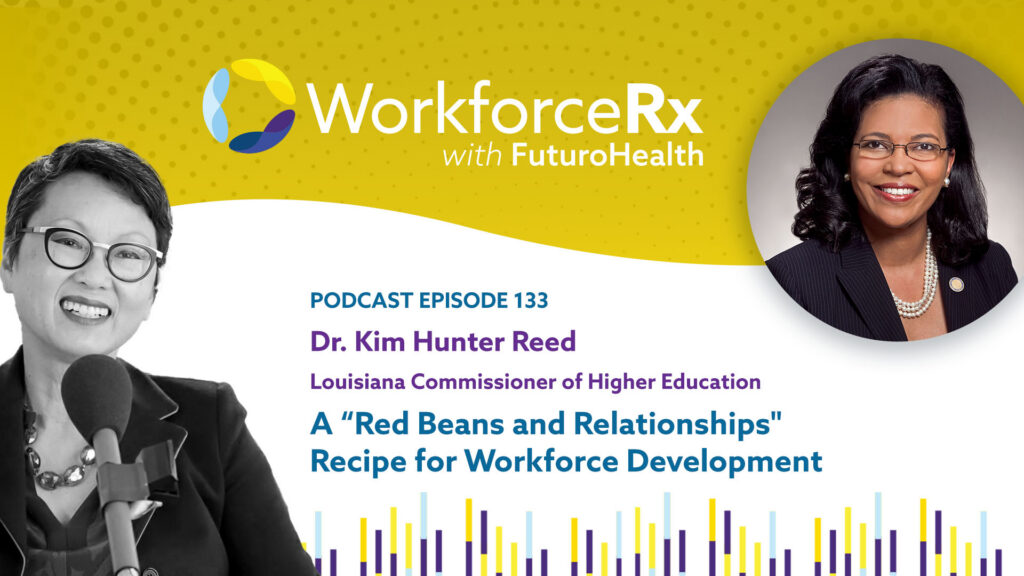
Dr. Kim Hunter Reed, Louisiana Commissioner of Higher Education: A “Red Beans and Relationships” Recipe for Workforce Development

PODCAST OVERVIEW
Mentioned in this episode: Louisiana Board of Regents
Transcript
Van Ton-Quinlivan
Hello, I’m Van Ton-Quinlivan, CEO of Futuro Health, welcoming you to WorkforceRx, an ongoing conversation with leaders and innovators offering insights into a creating a future-ready workforce.
Louisiana has experienced record levels of business investment over the last two years, led by multi-billion — not million — multi-billion-dollar projects initiated by Meta and Hyundai. This has put a spotlight on efforts by the state’s higher education system to produce the skilled workforce these companies need.
We’re going to explore those efforts today with Dr. Kim Hunter Reed, Louisiana’s Commissioner of Higher Education. In that role, Dr. Reed leads the state’s talent development strategy, which includes the ambitious goal of doubling the number of credentials annually awarded in Louisiana by 2030.
Dr. Reed has an extensive background in higher education and government, including leading the Colorado Department of Higher Education and serving as the Deputy Under Secretary of Education in the Obama administration.
It’s so good to see you today, Dr. Reed.
Dr. Kim Hunter Reed
It’s great to be with you, thank you.
Van Ton-Quinlivan
Kim, let’s start by having you outline for our listeners what’s happening in Louisiana’s economy and how is it driving your work as commissioner?
Dr. Kim Hunter Reed
Exciting information as you have shared… over $100 billion in investment. So a focus on diversifying the economy and some big wins in Liquid Natural Gas (LNG) and maritime and technology. But as you know, the real win in economic development is if the people of the state have the opportunity to fill the jobs.
So for us in higher education, when we think about talent development, we also now are thinking about talent retention. How do we develop great talent for the jobs of today and tomorrow? How do we retain that talent? So I definitely think all of higher education is more focused now on really aligning and knitting together our work between education and employment, understanding core competencies and what the market is looking for, being responsive and making sure that students and families who spend their time and their money with us are getting a solid return on their investment, that they see value in higher education. So, all of that is shaping our conversation, our policy work and our practice here in our state.
Van Ton-Quinlivan
How exciting. And now you have a master plan in Louisiana that’s been described as being rooted in a “red beans and relationships” approach. Tell us more about what this phrase alludes to and what you think it conveys about the work that should be done.
Dr. Kim Hunter Reed
You know, in Louisiana we always like a great meal. We like to bring people to the table and certainly red beans and relationships reflects, I think, so much of who we are, right? This is substantive, right? With red beans, you have to tend the pot. It’s not an instant meal. It takes time and creativity to get it right. And then a great meal is something to be shared. So the relationship piece really allows us to really think about how do we create something special in Louisiana for our people, and then how do we share that prosperity, share those opportunities.
So for us, we do recognize — as I know you do, Van, and the work that you have done in the research and your writing — we recognize that we don’t do this work in a silo. Our work must be fully integrated. We must hear from business and industry to understand what they’re looking for and whether or not we’re meeting the mark.
So these relationships — K-12, community relationships, relationships with business and industry, with government, with policy leaders, with faith leaders — all of that is important for us as we try to do this work, not just to serve the students we have well and to make sure that they have robust experiences into the marketplace, but to also try to ensure that we’re encouraging more in the community to be a part of higher education, whether it’s a technical community college, a four-year institution, an industry-based certification, et cetera.
The work has got to be wide and deep, and so building those relationships, inviting people to the table, listening well, being a part of something bigger than ourselves… I think that is really important for us.
Van Ton-Quinlivan
So for a moment, let’s talk about work-based learning. You had mentioned a few industries that you’re diversifying Louisiana’s economy into or strengthening the economy for. How are you setting up the incentives, the funding formula or whatever levers you’re doing in order to increase work based learning opportunities for learners…and I would assume that’s at all the levels of education.
Dr. Kim Hunter Reed
It is indeed. So first I would say that we know all the research clearly shows that when students have an opportunity to have a meaningful work-based learning experience – an internship, apprenticeship, co-op — that their earning potential is higher. The relevance of that work, the light bulb that goes off that connects them to aha, that’s why I’m studying this; this is what I’m gonna do with it, the relevance, I think it is very helpful in the retention of talent.
I think foundationally the call for work-based learning and the call for education to employment alignment signals for all of us in higher education a new definition of success. I think the goalpost has moved. I think we have moved from an era of access, more students coming to college, to success, more students completing, to now this conversation around what’s the value in the marketplace, what’s the value to the community, what’s the value to society.
So the value conversation I think really pushes on what are we doing to meet the mark when we recognize that if you ask families and students, as we’re about to welcome the new class in in this fall, if you ask them why be a part of the university or community college experience, you know, over 90% are gonna say to get a good job. And so for us to deliver on the value conversation means we have to meet them where they are and help them to do that.
As you know, community colleges are of and for the community, so they’re built to do that, very much integrated into the workforce. But we have to make sure that all students have those opportunities. And so I do want to make sure that we’re thinking about how to integrate better curriculum design. Strata Foundation has supported, I believe, twenty redesigned programs for institutions in Louisiana so they can rebuild their curriculum with meaningful work-based learning fully integrated.
They also have worked with us on their opportunity index for all states. We’re trying to customize one for the state of Louisiana that includes everything from faculty playbooks around how to actually intentionally include work-based learning in every field, in every discipline? How do we think about work study and redesigning work study so that it an existing opportunity for students becomes a more robust work-based learning opportunity for students? How do we make sure that career services is not a last semester last thought, but a first semester first thought? We’re asking students, what do you want to be? What do you want to do? How can we help you in that way?
So I think it’s a mindset shift for us. There’s some intentional restructuring and redesign that has to occur, deep relationships that have to exist, and then we have to measure our success and see where we’re missing the mark and where we’re meeting the mark and continue moving forward.
Van Ton-Quinlivan
So as you’re pushing on this work to make work-based learning more a norm than an exception, I’m sure the change management involved is not small. I’m wondering if you could give us a flavor of some of the aha’s or some of maybe the barriers and then what were the strategies to overcome and move the change.
Dr. Kim Hunter Reed
So, we’re young in the work. Senator Edmonds, who was our Senate education chair, passed resolution for a task force to do two years of work. So we’re one year in. We have business, industry, K-12, higher ed, elected officials, policymakers all at the table doing the work.
Some of the aha moments…one of them was like, we need more business engagement. We need to know why business perhaps is not participating in work-based learning. Do they even know about it? What are their barriers? So we have a survey in the field right now.
We talked with students and one thing that was interesting for students, which goes to the question of paid internships, was we found that students were excited about the idea of getting rigorous work-based learning, but many of them were not willing to give up their casual employment for work-based learning experience if it was not convenient to their schedule and if it was not paid. So obviously, we have to think about these things because this is what students are doing now, right, Van? They’re going to school and they’re going to work. The question is: can it be meaningful skill building as instead of casual employment? And so, how do we think about understanding the barriers for students and the barriers and concerns for business and industry, and further integrate that work.
Of course, we also have to have our faculty fully engaged and bought in and our campuses as well. And so ultimately I believe we will continue to push on this idea that we want to define quality, but we want the institutions, the deans, the faculty, the department heads to decide what that looks like for students. Whether it’s you know off campus, on campus, or some integrated model, but we just we just need to make sure that those things exist and they exist at scale.
So that’s why I think having Strata support these twenty curriculum redesigns will tell us a lot about what worked and what did not and help us to use that information to move the work forward as well as of course the survey of business and industry that’s in the field now.
Van Ton-Quinlivan
maybe you should come back on this podcast and share once the report comes in because this is has been a longstanding struggle and in the career technical education areas it’s more common to have the work based learning, but the hardship is that it takes more of the faculty’s time to go do the partnerships with industry and set up and coordinate these. And I’m sure on the general education side it’s just less of a norm. so bringing their support in would be important.
Dr. Kim Hunter Reed
So, maybe I should be asking you for some tips on how to make sure that works well.
Van Ton-Quinlivan
I think this is gonna be something that we all learn as a country. And I’m wondering have there been changes in how the colleges are playing with employers in response to the call from the commission as well as the legislature?
Dr. Kim Hunter Reed
Yeah, I think they really do understand that we do sit at a time now where everyone is asking the value question and they want to make sure that they’re able to answer it with transparency and success.
One thing that we are probably four years down the road on is academic planning. We’ve gone from this starfish approach of one bright faculty member bringing an idea and it moves through the process to us, to now having three-year strategic academic plans. We provide the labor market analysis to the institutions. The plans are shared with their local workforce investment group as well as their local economic development or regional economic development group to weigh in on the new academic plans that they’re pursuing.
And then at the state level, we engage the State Economic Development Office and the State Workforce Investment or Louisiana Works, the State Workforce Commission in the conversation. So again, that deep relationship, knitting together the conversation around what is needed now in the marketplace, what is needed in the future, and are these the right places to put our resources or to reallocate resources in a resource-constrained environment.
In the past we would certainly not have those conversations. We may have asked for a letter of support in the past. You know, is there a business or industry that thinks it’s a good idea? But the idea that we’re giving you labor market analysis, we’re asking you to analyze it, we’re having two steps of review that integrates fully workforce and economic development before programs are brought forward. That is a whole different intentional design meant to make sure that we do meet the moment and we do have the best information on which to allocate resources.
Van Ton-Quinlivan
That’s wonderful that you’re incorporating the Louisiana Works program or that system into the planning process. And what are you finding as complementary activities between the workforce system and the higher education system?
Dr. Kim Hunter Reed
Well, we work so closely together. You can’t get the work done without making sure that you understand the data sharing and all of the information that needs to be done. So we have continuous communication with our Secretary of Workforce and her staff. We have an adult financial aid program that requires that eligibility is tied to high-demand, high-wage credentials, so we are engaged with them in conversations about which credentials meet the eligibility requirements. We’re in conversations with them about where to invest workforce dollars. How do we ensure that more people have information about what’s the top jobs in the marketplace?
We just had an opportunity to co-work on a grant for justice involved individuals. They were tied up, but we had capacity in our agency to work on a grant together. And so we did that and we were just successful in receiving that grant from the Department of Labor, the Restart grant. So there’s lots of examples, large and small where we’re working together. as They’re working on developing a talent plan for the state, as we’re working on talent development itself and retention. I mean there’s a continuous conversation, continuous engagement with the workforce commission.
Van Ton-Quinlivan
That’s wonderful to hear that the systems are not competitive and are acting in collaboration. Now a few years ago, Louisiana started a financial aid program aimed at students pursuing credentials in high-demand fields — music to our ears. How is that structured? Is it for only adults or youth or both? And how has it played out?
Dr. Kim Hunter Reed
Yes. The MJ Foster Scholarship Program– it’s named after the governor who created the community college system. The way it worked for us is we continue to say we need adult financial aid. In our menu of options, we don’t have anything for adults, and we recognize that we have a significant number of adults who have a high school diploma or less as their highest credential in a in a knowledge economy that requires so much more.
So it’s not enough for us to say you need a better credential, you need a credential of value. We needed a way for people to have access to get on a path, right? And affordability is real. We’ve got to make sure we’re addressing that. So we’ve been working on the MJ Foster Scholarship Program. It’s been wildly popular. We’re very excited that the governor and legislature doubled the resources for it this year because every year we’ve had it, which is the last few years, we ran out of money in the first six months.
It’s just a tremendously popular program. So the program is working and we’ve done an in a review of the individuals who’ve earned a credential where we could track their employment since participating and the average increase for their earning has been $36,000, the average increase.
So it’s game changing and life-changing for these individuals, and now we’ll have double the amount of funding. So we’re looking forward to tracking that. We see more women, we see individuals thirty and older, we see more people in healthcare, but it is five top industries that are high-demand, high-wage, and those are the only ones that are eligible for this state-supported adult financial aid.
Van Ton-Quinlivan
And does the financial aid flow through the institutions that have the programs in the top five industries?
Dr. Kim Hunter Reed
Yes
Van Ton-Quinlivan
Okay, got it. And an issue that was wrestled with in my state is does it also consider the cost of living expenses or is it purely the tuition that is incorporated in that financial aid program?
Dr. Kim Hunter Reed
Yeah. It certainly does not include the whole cost. So we’ll continue to, as we advocate for it and talk about the success of it, we’ll continue to talk about the need to expand the actual amount. But no, it certainly doesn’t come near the total cost of education.
Van Ton-Quinlivan
Well, let’s talk about a slightly different population, which is the high school population. I’m sure you’ve done a lot of good work on dual enrollment. Maybe you could just give us a sentence on what that means for the listeners who are less aware. And what do you see as sort of the next phase now that dual enrollment is so popular?
Dr. Kim Hunter Reed
Absolutely. So dual enrollment allows high school students to go to college and earn college credit at the same time that they’re per participating and earning their high school diploma. It has been popular in Louisiana. We set this sort of book end approach of addressing high school students, supporting dual enrollment, promoting it, and adults is our book end approach to try to get more talent developed in our state.
So we have about 44,000 plus high schoolers that are enrolled in public institutions. The number is continuing to grow significantly, which is a great thing for us. We’re trying to make sure we have a one-stop website for people to get information. It is https://ladualenrollment.com/ to get information about the dual enrollment programs. Who’s offering them? Are they online or in person? What’s the cost? It also has testimonials and frequently asked questions. So sort of a one-stop for students around dual enrollment. We’re continuing to see more participation, more success, more interest.
The challenge for us is we do not have a state-supported financial program, so participation in dual enrollment has been the wild west for families. Some families pay no cost because their school district picks it up. Some people pay books or transportation, others may pay the full amount. And so we’re trying to continue to say this is important to make sure that students are on a path early, and we need to not just have integration of information and high schools and colleges participating in a robust way, we need to make sure we have a way to resource it so that all families can participate, not just high flyers or not just students who have financial means to be able to do this.
Van Ton-Quinlivan
And Kim, I want to pull on the thread of something you mentioned earlier, which is the programming or the focus that you have on justice impacted individuals. What are the main elements of the strategy that you put in place so that you can give advice to others who are interested in working with this population well?
Dr. Kim Hunter Reed
Yes. So first of all, I think it is important for a state agency to say this is talent to be developed. We know statistics show that about 80 percent of individuals who are justice involved are going to return to their communities. So whether you come to this issue from a public safety perspective — more education means left less recidivism — whether you come to it from a moral perspective, or just a workforce perspective, we know that we have to make sure that we’re providing the kinds of experiences for individuals that allow them to come back and have meaningful contributing lives in our communities.
So we have, of course, worked on education. I just visited the women’s prison last month with our task force. We have an untapped talent task force that includes community colleges, four-year institutions, our Louisiana Association of Business and Industry, Parole, and a number of individuals, including individuals who were formerly justice involved, who are helping us to develop policy and practice to make sure that we have good robust education and employment opportunities.
What’s working is that there are strong partnerships with colleges and universities and community colleges. So the women’s facility has a strong welding program, a strong horticulture program, upholstery, cosmetology. They asked for more technical programs. They want HVAC, they want plumbing, they want coding, those kinds of things. So we were there to listen to them — what’s working and what’s not — so that was a good conversation.
But Van, the big bar, of course, is employers who were willing to hire, and so it was great to have our Association of Business and Industry saying, we will co-host a job fair, we will invite people in, we will be a part of this business engagement for you to help get this done because it is critical that we’re able to point to good hires and highlight companies that have taken a chance on individuals and they’ve done well, very well.
And so we just need more, whether peer-to-peer conversation, to just have a broader tent of second chance hire hiring, right? Second chance employers. And so that’s the work that we’re trying to continue to advance as we move this forward.
Van Ton-Quinlivan
Are you seeing that there are certain industries that are a better match for the second chance work?
Dr. Kim Hunter Reed
I know that our poster industry has been automotive. They’ve talked about the individuals they’ve hired, they’ve talked about the power of hiring more, the quality of the training that is happening in the prisons, why they’re hiring individuals. So they’ve just been really a sort of pace car in the work. So that’s one example for sure.
Van Ton-Quinlivan
Well, you have so many innovations and such momentum happening in Louisiana. I feel like I should give you an opportunity to just tell us anything that we hadn’t heard yet before we go on to our closing question.
Dr. Kim Hunter Reed
Well, I mean it’s an exciting time. Obviously the work is challenging, but it’s never been more important. And ultimately I think in a world where there’s a lot of conversation and questions about price transparency and is college worth it and what about the value proposition, we as higher education leaders and believers in this work and consumers of it have got to do a better job of sharpening our narrative, defining and demonstrating value, and including more individuals in the work.
There is truth in some of the criticism, so we have to make sure we’re always on a quest to get better and to not just say they just don’t get us, right? We’re special, they just don’t understand. Again, to the red beans and relationships…we need to break bread. We need to listen. We need to be at the table together trying to make sure that there’s more opportunities than not. I’m gonna be always a glass have full person, but also a roll up my sleeve person, right? Doing the work, not just saying that it’s important work.
Van Ton-Quinlivan
What good advice you have for higher education writ large. Now let’s go on to our final question, which is: what makes you optimistic about the future of higher education?
Dr. Kim Hunter Reed
It would have to be the students, and it’s good that you’re asking me this question today. The Governor’s Fellows summer program just finished today. It’s a program where college students or recent graduates are embedded into state agencies to learn about public service and policy. This year we also had three high school students this summer that we hosted. And so to watch all of them embedding in policy at the table, attending meetings in conversation over pizza with me about what are you learning and what are you listening about? What do you what do you want to do?
And each of them had a presentation to make to me, Van. One of the high school students did a presentation on AI and medicine and it was graduate level presentation from a high school senior. So, as you know in your own great work, when you set the bar high and you model what it looks like to be included, to be successful, to be excellent, students will knock it out of the park.
So that is what makes me excited. Of course, the $100 billion plus investment in Louisiana means there’s opportunity for more people, so it puts wind in the sails for us to continue and to have urgency in our work. But it’s always the students that you meet, the students that you engage with, the families who are so excited and believing that this is going to be a new path, a path from poverty to prosperity for their children…that is what makes me excited and even more committed to this work.
Van Ton-Quinlivan
Well, the students always inspire whether they’re young or whether they are adults, and I see that you deployed the tried and true tradition of bringing pizza as a way to appeal to students!
Dr. Kim Hunter Reed
Absolutely. Yeah. And they all showed up.
Van Ton-Quinlivan
Well, Doctor Reed, it’s been a pleasure to have you today. Thank you very much for being on this podcast.
Dr. Kim Hunter Reed
Thank you. The pleasure is mine. Appreciate all your amazing work and enjoyed this conversation very much.
Van Ton-Quinlivan
Likewise. I’m Van Ton-Quinlivan with Futuro Health. Thanks for checking out this episode of WorkforceRx. I hope you will join us again as we continue to explore how to create a future focused workforce in the nation.