
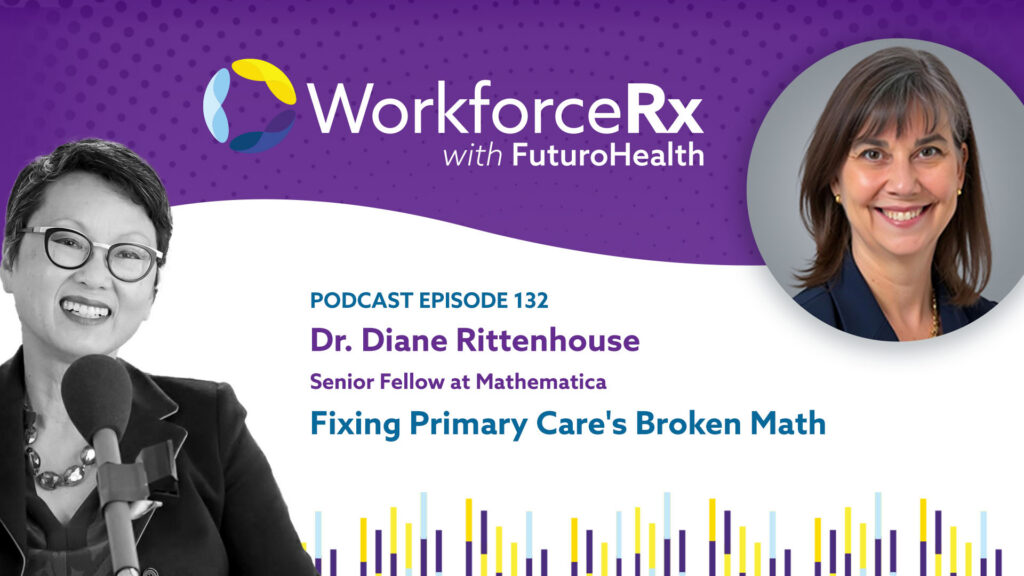
Dr. Diane Rittenhouse, Senior Fellow at Mathematica: Fixing Primary Care’s Broken Math

PODCAST OVERVIEW
Report On Strengthening California’s Primary Care Team Workforce
Transcript
Van Ton-Quinlivan
Hello, I’m Van Ton-Quinlivan, CEO of Futuro Health, welcoming you to WorkforceRx, an ongoing conversation with leaders and innovators offering insights into creating a future ready workforce.
It would take a single primary care physician 26.7 hours per day to deliver all the recommended care for the patients that he or she is responsible for. That alarming statistic sets the stage for a major report issued earlier this year from the California Healthcare Foundation that takes a hard look at a problem that, if not improved, will continue to deprive state residents of access to the care they need, and of course, that report has been presented to a national audience because this issue is not just one state’s issue alone.
Joining me today is the report’s lead author, Dr. Diane Rittenhouse, a senior fellow at Mathematica and professor of Family Medicine and Health Policy at the University of California San Francisco.
Her research on innovative ways to organize and deliver primary care has appeared in the Journal of the American Medical Association and the New England Journal of Medicine, and has been cited by major news outlets.
Thanks very much for joining us today, Dr. Rittenhouse.
Diane Rittenhouse
I’m so pleased to be here. Thanks for inviting me into this conversation, Van.
Van Ton-Quinlivan
So Diane, tell us a little bit of background on what inspired this work, and why did you think California, and perhaps the nation, needed to explore the primary care workforce?
Diane Rittenhouse
Well, first I want to thank the California Healthcare Foundation for inviting us to do this body of work and for publishing this report. Primary care is so important. It’s the front door to the healthcare system, but it’s also where people can get comprehensive coordinated care over time with someone who knows them and knows them well.
Primary care is where one ought to be able to go when you don’t know quite what is wrong, when you have a symptom or a concern or a worry, and to be able to get acute care for something like an ankle sprain or chronic care for something like diabetes over time, or preventive care like colon cancer screening or breast cancer screening should all happen in a high quality primary care setting. In fact, the National Academies has described primary care as unique because it’s the only part of healthcare where an increased supply is consistently associated with better population health and more equitable outcomes. So that’s why primary care is so important.
California has done a great job expanding health insurance coverage so that almost everyone in California has insurance coverage, but people in California still struggle with timely access to high-quality primary care, as do people all across the United States, and that’s because of workforce shortages and maldistribution of the primary care workforce. So getting access to primary care isn’t just enough.
As you said, if you have a physician who is tasked with the impossible job of delivering the amount of evidence-based care that is being demanded at this time of a primary care clinician, is just not doable without a strong team surrounding them, and so we really wanted to look at primary care access as a workforce issue and think about how do we look at the primary care team and really strengthen the primary care team in the state of California, but with relevant recommendations for places across the country.
Van Ton-Quinlivan
Diane, when people hear healthcare workforce, they usually jump to the conclusion that you’re talking about doctors and nurses. Your report actually takes a different approach. Tell us more about that.
Diane Rittenhouse
Yes, so doctors and nurses are very important to primary care, and there are other team members that play a critical role. Many people know when they go to their primary care office, they work with a medical assistant, for example, who might educate them about their diabetes care or remind them about an upcoming screening that they need to have, or take their blood pressure, for example. Community health workers can do outreach into the community. Clinical pharmacists can work in primary care settings knowing the patient and the team and really helping adjust medications for complicated chronic illnesses. Social workers can help with behavioral health conditions and help make connections to resources in the community.
So when we’re talking about a primary care team, we’re not just talking about doctors and nurses. We’re talking about physicians, nurse practitioners, physician assistants, nurses, behavioral health clinicians, etc. who come together and work with a patient to support them in their journey.
Van Ton-Quinlivan
And Diane, the federal legislation H.R. 1 has funding flowing out through the rural health transformation program. Does what you’re saying interpret for the rural community?
Diane Rittenhouse
Primary care is obviously just as important for rural communities, and there are often access issues in rural communities where it’s harder in some cases to recruit and to retain full primary care teams. Primary care in rural areas is also often more comprehensive because there isn’t this sort of bevy of specialists readily available to assist with care, and so primary care physicians or clinicians in rural areas often have an even more comprehensive job, in many cases helping to deliver babies or doing orthopedic procedures and that kind of thing. So it is just as important, if not more important, to think about rural communities as somewhat underserved and identify the supply and demand in those areas with good, strong data and bolster the payment to those areas and the recruitment to those areas and strengthen retention, especially in those areas.
Because one thing that we really know about primary care teams is when there’s turnover, it really weakens the team in so many ways. When you have one team member leave or team positions sitting empty, it just puts a strain on the entire team, and it’s harder to deliver high-quality care.
Van Ton-Quinlivan
Before we get to the question of what surprised you most as you worked on the project, I want to go back to a word that you used, which was maldistribution. So, what causes the maldistribution of these roles across geographies?
Diane Rittenhouse
We know that in California there are shortages of various members of the primary care team, and we know that they tend to be maldistributed so that in urban areas, for example, there are more than in rural areas. Part of that has to do with training. Part of that is that we bring people to urban areas to train them and then expect them to go back to rural areas and practice, or we train people in academic health centers and hospitals, and then we expect them to just naturally go into underserved settings in community clinics or in office settings where they weren’t trained. So part of our problem is that we don’t train the various members of the team in the settings in which we would like them to practice.
There’s some work in California and across the country to think more about how we can be training people in these community clinics and in community-based settings and training people together so that they’re ready to work in the kinds of settings that we need them to work in and play the kinds of roles that we need them to play.
Van Ton-Quinlivan
It seems like part of the design strategy is sending the team to the training so that they’re training together on how they work together, and then there needs to be some type of incentive or a reason for them all to come back to the community and apply those skill sets together.
Diane Rittenhouse
That’s absolutely right.
Van Ton-Quinlivan
And so what surprised you the most as you did the project?
Diane Rittenhouse
You know, there are a couple of things that really struck me. One was that as we talked to high-performing primary care practices around the state, they all had very similar challenges around workforce shortages, payment, recruitment and retention, training…the consistency was really striking. The fact that a leader at Kaiser Permanente would say, “We can’t recruit enough primary care physicians and enough MAs to work in primary care and enough clinical pharmacists.” Then we would talk to the VA, and they would say a similar thing, and then we would talk to an independent, privately owned practice, and they would say, “You know, we can’t recruit a clinician here to work with us.” And then we would talk with a community health center, and they would say, “You know, no one wants to come and work with us.”
It was so interesting because everyone seemed to think it was their fault and that they weren’t doing enough of the right thing somehow to recruit workforce to their setting. In fact, it has to do with the fact that the workforce is just in short supply and that the job has become increasingly difficult to do and that the payment structures don’t support the whole team. So when you have a payment structure that doesn’t support the whole team and you can’t hire a full team, then it’s hard to recruit people to come and do a job that is at times pretty overwhelming, as much as it can be very rewarding. So the consistency across settings was really interesting and striking.
The other thing that really struck me was on the training side of things, when I talked to people who were working in educational institutions and training programs, you know, they’re either dissuading people from going into primary care because it’s hard and it’s not as well compensated as other parts of the healthcare system — like a cardiology practice or a hospital setting — or they’re simply training in the old siloed model where nurses train with nurses mostly in a hospital setting, and pharmacists train with pharmacists mostly in a community pharmacist setting, and doctors train with doctors.
This idea of training for the future just really has not yet taken on, and I thought that was striking. It was notable that training has not kept up with the vision, except in some pockets. There are pockets of innovation, but overall I would say much progress needs to be made.
Van Ton-Quinlivan
Both of those issues you talk about — the fact that there are similar challenges — lead me to think that there’s a talent puddle, right? So just competing for talent is not enough. And then this issue of training not keeping up with the times or not keeping up with the future, neither of these are small issues. So, before we get to the payment structure, which is not a small thing, help us understand the distinction between roles and functions, and then also scope of work, for those who are not from the healthcare field.
Diane Rittenhouse
Right, so scope of work really has to do with what people are allowed to do under their particular license or certification in the state, and that can vary widely from state to state depending on the certification bodies. So, a nurse practitioner may be able to do certain things in one state that they have to be supervised for in another state, for example. Roles and functions we take on in the report because there are certain functions that are essential to primary care, and they include things like prevention, chronic disease management, behavioral health integration, medication management — and they’re really the job of primary care. What needs to happen in a primary care practice? Then the roles, we talk about, well, there’s nurses — there’s maybe a licensed vocational nurse, or there’s a registered nurse – and they have different levels of training, and they could take on different functions.
Maybe if a patient has a very complex set of medications, is older, and needs someone to go through their medications and adjust them on a regular basis according to how they’re doing physically and how they’re doing mentally — and maybe even decrease some of their medications if they’re having some side effects or that kind of thing — that job could be done by a physician, but it doesn’t need to be done by a physician. It could be done by a clinical pharmacist, someone who has pharmacy training but is embedded in the practice and knows the team that’s caring for this patient and knows their circumstances well. Or it can be done by a registered nurse.
So that function of complex medication management has to happen in the primary care practice, but it could be done by a variety of roles. In some practices, we found they have union rules that only allow them to hire registered nurses, for example, and they cannot hire LVNs or something like that, and so in that practice, maybe the RN would take on that role. In another practice, they can’t get reimbursed for hiring RNs, but they have a special arrangement to bill for a clinical pharmacist, and so they have a clinical pharmacist playing that role. In another practice, it may just be the physician that takes it on.
Van Ton-Quinlivan
So you mentioned earlier that some of the roles on a primary care team may include a medical assistant, a community health worker, pharmacist, social worker, amongst the list. So these are the roles, and then it sounds like functions, as you begin to do team-based care, each role may take on different functions, maybe a new set of functions, and maybe not do some things that they were doing. So, then let’s tie it back to the training institution. If the training institutions are struggling with evolving how they teach these skills or what they’re teaching each of these roles, and it tends to be role-based, where do you see the bright spot in terms of the kinds of institutions or the kinds of settings that would actually train toward the team-based care that you’re envisioning?
Diane Rittenhouse
Ideally, schools will take this on. Some medical schools are taking on the job of interdisciplinary training and are working with schools of nursing, schools of pharmacy, schools of social work, etc. to help their students at the student level or at the residency leve better understand who these different people are and what kinds of things they can do under their license and certification. Because that’s part of it. If you go all the way through medical school without ever being taught what a nurse can do and what a nurse can bring to the table, if you will, you tend not to value that person as highly because you don’t understand what they can contribute, what they’re trained to do. We talk a lot about working at the top of their license, and the ideal would be that each person that has a license or certification or training is using that maximally.
It’s interesting, I remember one time talking to an independent primary care practice that had worked out a way to bring in a social worker and have that social worker’s efforts paid for, and that social worker was able to do some behavioral health screening, they were able to do some referrals to community services, and they were really an asset to the primary care team. I asked the physician who owned and was running the practice, “Would you ever think about bringing in a clinical pharmacist?” And the person said, “I’m just barely trying to figure out what this social worker can do. I have no idea what I would do with a pharmacist.”
So, it’s a lack of training, a lack of understanding, a lack of just knowledge about what the different roles could be and how the different functions could be divided up. Because team-based care really requires trust, it requires knowledge of what each other’s skills are, and it requires experience having worked, and it requires trust in that. So what I’m hoping is that we’ll see more and more universities combining their students in some ways to train people so that they have this kind of understanding.
In a primary care setting, it’s challenging. It’s very challenging because there’s a lot that goes into those curricula, as you know, and doctors have always sort of trained with doctors and nurses have always trained with nurses.
Van Ton-Quinlivan
That’s a good point. You’ve mentioned payment several times across several questions. Tell us more, Diane, on why does payment matter so much to the workforce roles and functions?
Diane Rittenhouse
It’s interesting because we set out to write a report that made primary care workforce policy recommendations, and we ended up with one of our six recommendations is to change the way primary care is paid for. It became so clear that payment really shapes the workforce, that practices hire the teams they can afford, not necessarily the teams that patients need, and that training programs train for jobs that exist in the marketplace. So if services of a clinical pharmacist or a nurse cannot be paid for or reimbursed in a primary care practice, then they won’t be hired in a primary care practice. Then the training programs aren’t going to produce the professionals that could work in a primary care practice. They’re going to train people who could work in a hospital because that’s where there are jobs. So it really is interconnected in a very important way.
We tend to pay doctors for doing things to patients. We tend to pay for procedures, we tend to pay for visits, we tend to pay for doctors or for clinicians. We don’t tend to pay for all of that work that happens in primary care in between visits, or in between a doctor doing something to you, where a nurse calls you on the phone, where a medical assistant has you in to take your blood pressure, where someone reaches out to you with some patient education. We don’t tend to pay for that piece of primary care, which is a problem because primary care then has been traditionally massively underfunded, and so they’re running with not enough funding to really support the work that needs to be done. Then it’s hard for them to hire team members to help because they can’t get reimbursement for those services.
So then again, training programs decide, well, why would we train someone to go work in a primary care setting if there’s not going to be a job there? So these things have to be, it’s multifaceted, and I don’t want to be too discouraging, but it’s a big problem, and we’ve got to work on lots of pieces of it, and that’s why our report put out recommendations that really address not just training but also data and payment and retention and other aspects.
Van Ton-Quinlivan
Tell us more about your recommendation on workforce data. Why is that so foundational?
Diane Rittenhouse
Data is important because if we don’t have good data, we can’t inform good policy. We need good data to understand the workforce we have and where it is located and what people are doing so that we can understand where there are shortages. We can better understand the question that you asked me earlier about maldistribution. We can better understand things like language and racial and ethnic concordance. Right now we have a situation where only seven percent of the physicians in the state of California are Latino or Latinx, and nearly fifty percent of the population is Latino or Latinx. So how do we start to create a primary care team workforce that is sufficient, distributed well, and reflects the population without having good data?
One of the things that’s happening is the state of California is improving its data collection, and that’s really a positive thing. They’re doing licensing surveys so that you can get information when people go to get a new license in healthcare, they have to fill out a survey, and we get more information about them. We’re working on trying to figure out how to ask more questions on those surveys about primary care so that we can tell if people are working in primary care or not. That’s for some part of the primary care team. There are other parts of the primary care team, like medical assistants and community health workers, where we just don’t have any data. We really don’t know how many there are and where they’re being trained and how they’re being trained. So it’s just very hard to improve something that you can’t measure.
Van Ton-Quinlivan
You mentioned cultural concordance and language skills being important in the healthcare workforce. I wonder if you could just draw the dotted line. What’s the importance of having the workforce reflect the patient community, and how does that tie into health outcomes?
Diane Rittenhouse
So, we know that the primary care workforce ought to match the population in terms of race, ethnicity, and language, and we call that concordance. The importance there is because people need to have trust in who’s providing care for them, and they need to have someone who understands their context and who can speak their language. We can do that through translators to some extent — and some proposals have been to bring in physicians from even other countries who have that context — but really, it is our responsibility, I think, in the state of California, to train people into the healthcare workforce that can meet the unique needs of our very diverse population.
We do have evidence that language concordance and racial and ethnic concordance improve health outcomes. So that’s just a really important piece of what the state is working on, in terms of not just having enough members of the health workforce but having them distributed across the state in a way that’s equitable and having them look like and be able to provide context and language skills that match the population.
Van Ton-Quinlivan
So you’ve highlighted a number of issue areas, and I’m sure there’s a much longer list that listeners should reference the report to view. I wonder, if we gave you a magic wand and you could wave it, what one change would you want to do tomorrow that would make the biggest difference?
Diane Rittenhouse
I would say payment because if we don’t have enough money going into primary care and it’s not well enough resourced such that we can hire primary care team members to do the work or the functions of primary care and create a job market for the jobs in primary care that we know we need, we’re not going to be able to increase access for the population. So it feels foundational to me that we put enough money into primary care, and the state has set a goal of fifteen cents on every healthcare dollar spent would go to primary care, so that’s real progress. It’s directed in a way that doesn’t just pay doctors for visits or for doing something to patients, but it actually pays for the primary care team to care for a community of patients.
Van Ton-Quinlivan
Now, I have to ask you the AI question. Do you see AI fitting into the future of primary care and changing perhaps how the team is composed or the skill sets or functions of the team members?
Diane Rittenhouse
It seems like AI is fitting into everything, and it is definitely the future, and I think there are ways in which it will make primary care and healthcare generally better, for sure. I think it has tremendous potential in primary care specifically to reduce documentation burden for the team — all of the note-taking and entering things into the electronic health record. Sometimes people have hired actual people, scribes, to take notes for them in a primary care visit so that they’re not at home late at night typing into the electronic health record, or they’re not spending the entire visit with a patient staring at the computer screen. So some of that has already been replaced by AI, and AI does a very good job of that, and that really reduces the burden on the primary care team.
There are other support functions like billing, and there are other ways in which AI can help identify people for outreach, like who might you need to call to come in for a visit, or who’s due for a breast cancer screening, or who’s due for a checkup for their diabetes, etc. So there are ways in which AI can help with what we call the population health function.
I am quick to say that AI not is going to replace a core member of the primary care team that is sort of cross-trained to deal in a flexible way with the core functions of primary care, anytime in the near future. I think if anything, in the near future we need to add to the team a bit with training, with expertise and knowledge of how AI works and how it can best be employed in the most effective ways and increase and improve quality and increase access rather than harm quality and access.
Some people ask if AI going to take over the job of the primary care doctor or the primary care team? I do not believe that. I believe that primary care is built in continuous relationships with a person over time that you know and who knows you and who knows your context and can help you work with AI and understand all of the various inputs that impact your healthcare, and I don’t think that relationship is going to go away anytime soon.
Van Ton-Quinlivan
Before we get to our final question, Diane, I was wondering if there are any additional points you wanted to make from the recommendations of the report.
Diane Rittenhouse
I just really think that primary care is at a crossroads. It feels sometimes a bit old fashioned because it’s not the shiny new procedure or technology, it is a relationship-based part of the healthcare system. There’s a big part of it that is sense making and that provides the entree to the healthcare system and the coordination across the healthcare system. So we know that it is important and we know that it improves outcomes. I think in our culture we tend to look quickly at the new and the shiny and the technological and the invasive and the procedures. So I think we’re at this crossroads where primary care has been under-resourced and undernourished, and we really need to bring more resources to the table for primary care.
We need to pay equitably for the primary care team, and we need to really strengthen the team, not just in California but across the country. What I’m really excited about is the fact that California has recognized the importance of primary care and is really building some momentum around strengthening the primary care practice and the team that works within the primary care practice. There are a number of policy interventions that are happening that really highlight, or demonstrate, that that momentum is happening, and that excites me.
Van Ton-Quinlivan
Well, thank you for putting the spotlight on this weakness we may have in our care infrastructure. So now let’s go on to our final question. What makes you optimistic about the future of care?
Diane Rittenhouse
I think it is this notion, just to build on that, that California has momentum. We’re not trying to convince people anymore that primary care matters. The leaders in our healthcare system understand that primary care needs strengthening, and there’s important work underway around all these levers that we identified in the report: payment, workforce training, data. HCAI, the state agency for workforce education and training, is improving workforce data collection and prioritizing primary care in workforce development. OHCA, the Office of Health Care Affordability, has set the primary care spending target that we talked about so that we would spend fifteen cents on every dollar in the state of California on primary care. Health plans are beginning to move from this sort of aspiration of, yes, we believe that primary care is important, to how do we actually make this happen? How do we actually spend fifteen cents of every dollar on primary care? There’s a primary care scorecard that’s coming out soon for the state of California that helps us keep track of the primary care infrastructure.
So, while the challenges are very real and very complex, I really feel like California is the right place to be at this moment, that there’s a lot of pieces in motion, and that all creates real opportunity for progress.
Van Ton-Quinlivan
Well, thank you so much, Diane, for being with us today and doing a lot of sense making.
Diane Rittenhouse
Thank you for having me. I so appreciate the opportunity.
Van Ton-Quinlivan
I’m Van Ton-Quinlivan with Futuro Health. Thanks for checking out this episode of WorkforceRx. I hope you will join us again as we continue to explore how to create a future-focused workforce in the nation.