
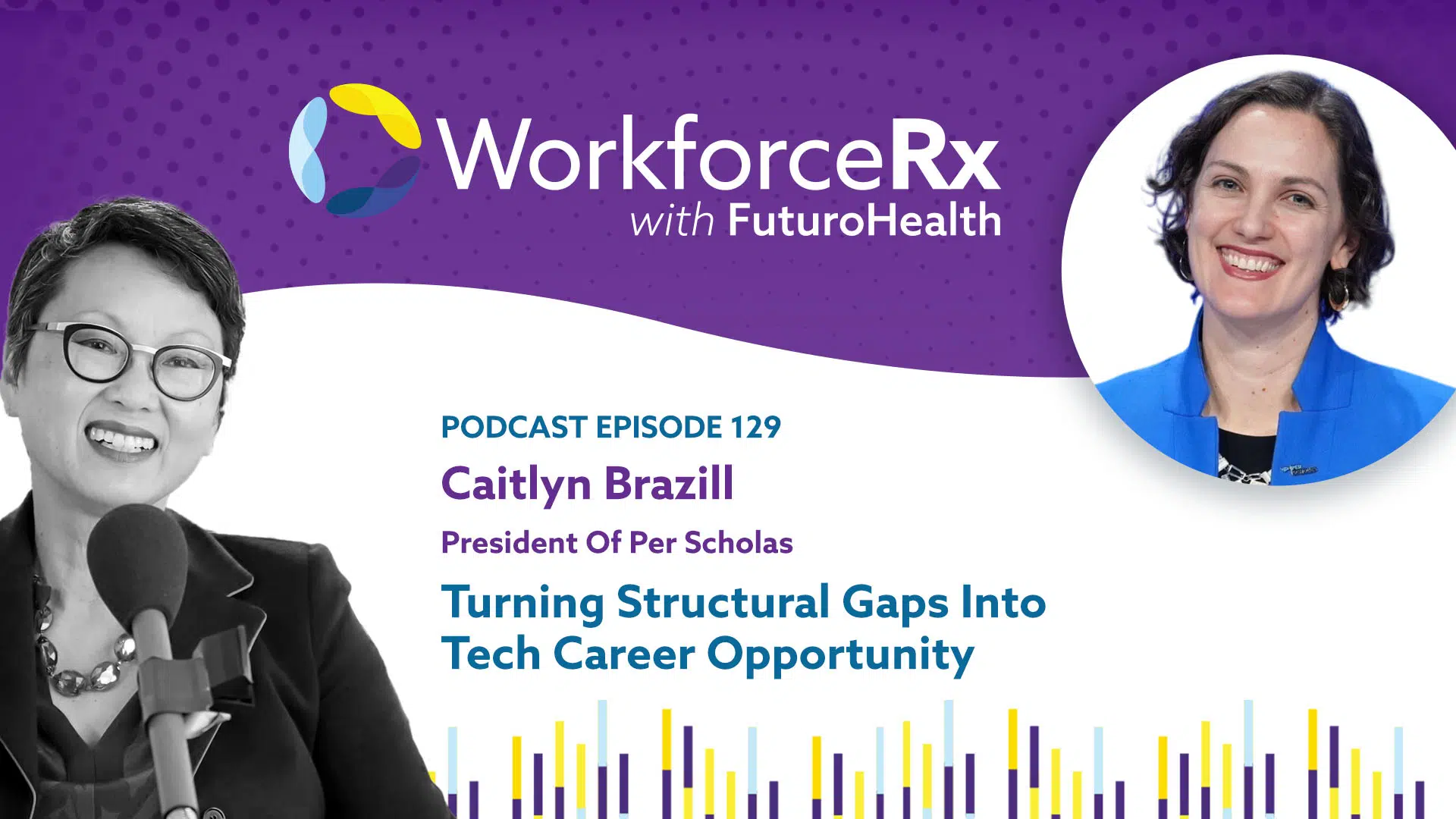
Caitlyn Brazill, President Of Per Scholas: Turning Structural Gaps Into Tech Career Opportunity

PODCAST OVERVIEW
For more information visit: https://perscholas.org/
Transcript
Van Ton-Quinlivan
Hello, I’m Van Ton-Quinlivan, CEO of Futuro Health, welcoming you to WorkforceRx, an ongoing conversation with leaders and innovators offering insights into creating a future-ready workforce.
Tech occupations are projected to grow at roughly twice the rate of the overall U.S. workforce over the next decade, yet 87% of technology leaders say they face challenges finding skilled talent.
On today’s program, we’re going to take a look at a model for supplying that talent with Caitlyn Brazill, president of Per Scholas, a nonprofit that provides no-cost employer-aligned technology training to adults at more than 25 locations across the US. Over 30,000 graduates have launched careers in tech through Per Scholas to date.
Prior to joining the organization nine years ago, Caitlyn held leadership roles at NYU’s Furman Center for Real Estate and Urban Policy and the New York City Department of Consumer Affairs.
Thanks very much for joining us today, Caitlyn.
Caitlyn Brazill
Thank you so much for having me, Van.
Van Ton-Quinlivan
Well, let me ask you, what would you like to add onto my very brief description of Per Scholas, and everyone wants to know whether AI adoption affects the work that you do today?
Caitlyn Brazill
Well, I would say, Van, that I think AI adoption affects the work that nearly everyone does today and certainly is very much at the heart of what Per Scholas does. I think I would add to the description that you gave — thank you — that across the US today there are tens of millions of Americans who are working full time but don’t earn a living wage. In fact, there’s 53 million people in that position who are doing everything right and still unable to get ahead. And at the same time, the labor market is sending this very different signal. So by 2030, there are more than 2.1 million technical roles that are currently expected to go unfilled. And that includes the jobs that are needed to build and maintain America’s AI infrastructure.
So we’re left with this contradiction, right? That opportunity does exist at scale, but access to those opportunities do not. And this is not a short-term gap, it’s a structural one. It’s driven by rising technical complexity, shifting entry-level requirements, and a workforce and education system that hasn’t kept pace with our changing economy. And it is that gap that Per Scholas exists to close. So what makes our model work is simple but it’s powerful. We train people for real jobs that employers are actually hiring for, which means our curriculums are co-created with industry partners and updated continuously so that our learners are graduating with skills that are immediately relevant. For example, this month we’re launching a new critical facilities technician training program in Atlanta in collaboration with Microsoft.
Today, our primary focus includes AI-enabled roles across a wide variety of skill sets and industries. So cybersecurity, cloud, IT support, data analytics, fields that are actually critical in healthcare. We’re building the talent to power this AI technical revolution, but also to ensure that industries can benefit from the kind of automations, the kind of agentic solutions that AI has now brought to the fore.
Van Ton-Quinlivan
Well, Caitlyn, I have a son that is in college and for other listeners that are out there thinking about what advice can I give to my children, my nieces, my nephews, those that are undertaking education right now — I think there’s a lot of concerns because the computer science majors who were in such high demand are facing a tough job market. So as you think about the types of roles in tech, which ones are more likely to persist, which ones are shapeshifting, and which ones are sunsetting? What insights can you give us as you’re working with technologists and leaders of technology implementation?
Caitlyn Brazill
Yeah, well, you know, at this point it’s probably become kind of trite, Van, that most companies are saying you’re not gonna lose your job to AI, you’re gonna lose your job to the person who knows how to use AI. And I cringe to repeat it, but it’s really true. So it is a moment where understanding how to effectively use tools in a broad range of occupations, right? This is people who are finance majors, this is people who are accounting, HR, business process analysis — really, really across the gamut, we now have an ability to do our work differently. And within companies today, everyone’s trying to catch up, right? That means that there are folks who are highly proficient in a given skill set but who haven’t yet learned how to do that same work using AI. And I think for people who are entering the job market for the first time, there’s a unique opportunity to become that real master of AI tools and bring that into an organization and learn then about the expertise that’s held inside that company and those organizations today.
I think the other place where we’re seeing incredible demand at this moment is that there are a set of roles across a broad swath of industries that require a combination of digital knowledge, specialized skills and competencies, and physical in-person interaction with infrastructure, meaning data center technicians, the people who are managing critical facilities inside of hospital systems, advanced manufacturing. We now have a set of mechanical needs across a broad array of industries that are highly automated, which means that they require pretty sophisticated digital understanding, but can’t be completely managed or maintained without real people who are really engaging every day with complex, sophisticated, and frankly expensive machinery. And so I’d say in the immediate term for organizations like Per Scholas, this is where we are focusing our efforts and energy because right now we see a strong gap between the supply of that skill set and the demand, which is much greater.
But I do think over the longer term, as we see that skilled demands will fluctuate, right? And I cannot tell you what the labor market is going to look like three years from now. I wouldn’t have made the right guess three years ago. What is very clear is that employers are looking for people who have a demonstrated interest and willingness to continue to learn and adapt, people who can solve problems, who can think critically, and who can work as valuable members of a team. And I think that cuts across whatever your major was, whatever your skill set is — that’s not something that can be easily or effectively replicated through pure AI automation.
Van Ton-Quinlivan
Thank you for that perspective and guidance. And now, Caitlyn, let’s dive into the Per Scholas model specifically. So you have component parts that have come together to create a model that’s different from the traditional models. I would love for you to share — there are many listeners who come from a workforce background and higher education background — what are the key component parts that make Per Scholas bring success to your participants? Which parts are scalable in the sense that you can go to twenty-five geographies and you can go with those component parts, and then which are maybe place based?
Caitlyn Brazill
Sure. You know, because we’re an organization that has grown from one small organization here in the South Bronx where I’m sitting today, to 25 campuses across the US that are training six thousand people this year, we’ve spent a lot of time thinking about the non-negotiables, right? What are the component parts that need to exist in every market in order for it to be a successful Per Scholas program?
And I’d say it really starts with our dual customer focus. We see our employer partners as just as critical to our partnership and our success as our phenomenal learners. And because of that, that means that we have a really comprehensive and sophisticated in-house curriculum development team who works hand in glove with employers to understand the skill sets they need today. Present tense, right? Not three years from now. We have a real present orientation, and to build and adapt curriculum quickly to be able to meet those demands.
One of the other pieces, which is newer for us, is that we’ve taken that team and that work and really used AI to digitize that infrastructure in such a way that makes it much easier for us to create consistent experiences for all of our learners, regardless of who their instructor is. Meaning that everybody’s operating from the same learning management system, the same systems. I think some of the other components that are critical to Per Scholas’ success are that we create an atmosphere — whether you are participating in a fully remote training, whether you’re here in person on our campuses — that is highly professional and truly demonstrates respect for our learners.
We have very high expectations of our learners and of our staff and we make it very clear that we are confident that every person who has been offered a seat at Per Scholas is deserving of it and can meet those expectations. I think that shows up in every interaction, that shows up in the rigorous coursework, that shows up in the kinds of supports that we layer on for our learners, which include financial coaching and MSW-credentialed navigators. That shows up in our professional development, which is about 20% of our class time spent on the kind of soft skills coaching — communications, working in teams, conflict mitigation, presenting yourself — that we know are so critical, not just to landing that first job, but really to excelling within your career.
One of the other components that I think is somewhat unique at Per Scholas is that we have in every single local market teams of talent solutions folks who are working directly with employers. They are both helping to create matches between our graduates and employers, but also serve as a critical feedback loop and help our curriculum team to understand how are things evolving, right? Not just how did this one single person perform at your company, but where do you see your hiring needs going and how do we anticipate what you’re going to need in six months so that we can actually design against that?
And then the final piece that has been a really strong component of the Per Scholas model over the last five or six years has been something we call Career Accelerator. So after people complete our immersive training, which is typically fifteen weeks of full-time tuition-free instruction, all of our learners have access to free upskilling opportunities that can be completed nights and weekends, can be done self-paced on your own, a broad catalog of upskilling that builds on the foundational immersive courses that they completed at Per Scholas and that you can continue to access as you go through your career. And we’ve seen this help our learners advance their careers at a much faster pace than they otherwise would.
Van Ton-Quinlivan
Curious on the work experience component. You know, every employer, if they had a choice, would love to have the formally trained individual who also comes with the portfolio and work experience. So how do you equip your graduates to be as competitive as they could be?
Caitlyn Brazill
I saw recently a stat that said something along the lines of 92% of entry-level roles were requiring two or more years of experience, which is a pretty interesting concept that perhaps may eventually become a real challenge for those employers. You know, part of what we do is our entire training experience is meant to replicate and simulate the workforce. So, for example, in our IT support courses, from the first week of class, our learners are actually operating in the kind of ticketing systems that they would likely be operating in within those companies. We have hands-on labs that comprise probably 30 to 40% of each of our classes that are designed specifically with employer partners and replicate the kinds of projects that we expect our learners to be working on. So we bring a lot of that work experience right into the classroom.
We also bring our learners to the work. So part of our professional development component is to create strong connections with the companies that hire our grads while our learners are still in their immersive learning mode. So that may include things like mock interview reviews or resume reviews as corporate volunteer activities. It can also include visits to companies that are active hiring partners, or things like lunch and learns where we can deep dive on a particular topic that a company is currently wrestling with. And I think all of those help to shape that experience.
The other thing I would say is that Per Scholas has a laser focus on bringing in people to launch high-growth careers who have experienced barriers to economic mobility — structural barriers, circumstance barriers, sometimes the barrier of that voice inside their head. But what we don’t do is exclude people based on demographic categories. So our classrooms might have an 18-year-old who just finished high school sitting next to a 40-year-old who has had twenty years of experience in retail or hospitality or has been doing gig work.
We might have a person who has three children next to a person who has just gone to college and is trying to figure out how to get into that first role. And I think the diversity of those classrooms themselves lend themselves to a lot of the kind of sharing of workplace norms and expectations that help to layer on to our professional development work and help ensure that our learners are prepared much more realistically for the workforces that they’re likely to encounter.
It also means that many of our learners, while they may not have any prior experience in the particular role for which they’re training, do have relevant experience. And one of the things that we try to help them do is translate the skill set that they developed as a manager at a CVS into what it will be like to lead a team of software engineers, right? We help people who have had experience in a broad range of hospitality or other kinds of functions describe how that work helps them drive excellent customer service or project management in the roles that they’re looking for.
Van Ton-Quinlivan
You’re serving six thousand learners this year and they’re coming out of a fifteen-week program with no debt, tuition-free, which is wonderful. What a wonderful gift. Tell us how you are able to do that. Do you start with having a sponsor in hand? How does that process work for those in the audience who might be interested?
Caitlyn Brazill
Yeah, so we work with about a thousand employer partners across the US. Many of those partners contribute to our overall cost of training. Some actually sponsor specific customized training cohorts that give them first right of interview for all of those learners, and also we design content specifically for those employers. We are also able to resource our work more broadly through the generous contributions of foundations and individuals who care and are committed to economic mobility, and to some extent through the public workforce system, which is able to fund a small share of the total cost of the training that we are able to provide tuition-free.
But you know, certainly I think our employers are key to that entire ecosystem, both in terms of sponsoring training, but I think even more importantly, in terms of giving us the insight that we need to design the training tracks that they need and to work actively with a workforce partner. I’ll also say, Van, one of the things that’s been an interesting outgrowth of the last two years of AI adoption is that many of the HR teams that I’ve been talking to have been truly overwhelmed by massive increases in the number of applications that they get for every single open role. And that’s at least in part because folks like us have been teaching everybody how to really easily and effectively apply for lots of jobs at once using AI.
But it makes it that much more important and valuable to have a partner who can help you sift through that noise. You know, one of the things that we offer our employer partners is that we’ve just spent three months, 500 hours of content plus multiple hours of homework with each of these folks. We really understand their strengths, their challenges, what they bring to a team from a much more nuanced perspective. And so the ability for a talent acquisition team to work with a trusted partner like Per Scholas to help them make choices about new talent that they’re bringing on, I think actually has greater value in an atmosphere where suddenly the sheer volume of applications is so high that if you were using any kind of just filtering mechanism, you’re going to end up with a really homogeneous talent pool that probably isn’t actually what you want.
Van Ton-Quinlivan
Hmm, I appreciate that insight. Now before we transition topic, I want to give you a bragging moment. Are there some KPIs or impact outcomes that you’d love to share, Caitlyn?
Caitlyn Brazill
I mean, I’m incredibly proud of what Per Scholas has been able to achieve. You know, in the thirty years that we’ve been doing this work, we’ve enabled more than 30,000 people to launch careers in technology. We’ve helped them to increase their incomes by a collective $2.1 billion, which is truly impactful when you think about that at a community level. On average, we see our learners increase their income by about 3x — in the first job that they had, or in the roles that they had before Per Scholas, to the first job that they have afterwards.
And through Career Accelerator, those alums who take advantage of it, we actually see them increase their earnings in the first two years of their career by about 30%, which is about 2x what we see for the folks who don’t take advantage of the Career Accelerator. So, a little pitch to all the Per Scholas alums out there — it’s really well worth it.
Van Ton-Quinlivan
It’s great for them that they’re coming back to the well in terms of building up their skills.
Caitlyn Brazill
Yeah, it absolutely is. I mean, when I think about what are the outcomes that we’re really proud of though? To me it always just comes back to stories, right? So I can think about a woman who I met last year, Janae Smith Ramsey. She grew up in Atlanta, left school at sixteen as a single mom. She worked for years as a hairdresser, she was cleaning houses. She certainly never imagined that a tech career was something that she could reach. But she found Per Scholas through a friend. And one of the things that she told us was that as soon as she walked in the door, she felt like she was being treated as a respected professional and it entirely changed her outlook on something that she was probably rightly skeptical about.
I will tell you one of the biggest challenges we have, Van, is that everybody finds it difficult to believe that free training is really free. So our learners come in skeptical. But she completed our IT support course, then did some Career Accelerator courses in cybersecurity. Because our training was so closely correlated to the real-world demands that we were seeing in Atlanta at that time, Janae transitioned seamlessly into a role as a data center technician at Google. She’s already had promotions in that role.
Today she’s tripled her income and created a permanent generational shift for her family. I think to me, her story is one that’s just a reminder that when we remove the barriers and create an experience that is challenging but possible, we don’t just help people participate, we really help them to lead.
Van Ton-Quinlivan
What a great story. And I can tell also that you’re a fan of stackable credentials, which I am as well. So tell us what you all are doing in that area.
Caitlyn Brazill
So when it comes to stackable credentials, I mean, that’s really where Career Accelerator comes in for us. I would say a lot of our emphasis over the last couple of years has been in AI. So we have probably today, I don’t know, a few dozen different courses that our learners are accessing feverishly….that range from sort of basic prompt engineering to agentic solutions.
We also do a lot of partnerships. So you know, we work with IBM Skills Build, with the Google Career Certificates. We have a new partnership I’m not quite allowed to talk about yet with one of the frontier AI organizations. But in each of those cases, we are trying to ensure that our learners have access to the latest and greatest in educational offerings. And wherever possible, that we are able to bring in industry-recognized credentials to help employers really understand what knowledge and competencies our learners have. So we’re longtime partners of both Cisco and CompTIA and have delivered their stackable credentials for many, many years.
I think one of the things that’s part of Per Scholas’ special sauce when it comes to those stackable credentials is that the thing we bring to the table is we really understand how our learners need to learn. So one of the things that’s been really fun as we’ve been approaching AI is that we think of this not just as content, but also as how can AI entirely reframe our learner support systems?
So today, learners at Per Scholas meet their AI buddy, Azari, on the first day of class. And Azari will help provide personalized instruction, identify learning gaps, support coaching interventions. All of this is enabling us to scale while supporting our instructors in the classroom and maintaining or even improving our outcomes.
The way this has shown up in terms of outcomes so far — and we’ve been testing Azari for about a year now — we can see that our learners who had access to Azari when we initially started the test had nearly 25% higher likelihood of passing their certification exams on the first try compared to the courses that didn’t have access to Azari. Now that is a huge jump and really came from essentially tutoring and creative personalized support.
One of the other ways that we’re seeing AI show up in all of our classrooms is that part of the Azari functionality is actually an interview prep bot. So Azari can take on multiple personas. It could be an HR interview, it can be a technical interview, it could be a whiteboarding interview. But what’s really remarkable, of course, is that you can practice with Azari for hours on end, right? A team member will not be able to give you fifteen hours of creative, thoughtful feedback on your mock interviews. But Azari can, and that’s been a huge lift for both our staff and our learners.
I think kind of across the board, what it means is in addition to all of the content that we are helping our learners access when it comes to AI, they finish our program with just the sheer number of reps of using AI tools that prepares them to really come into the workforce as an AI-native employee.
Van Ton-Quinlivan
What wonderful use cases of AI in our workforce development and training world. So Caitlyn, you sit on national policy bodies focused on economic mobility and workforce development. What’s the policy conversation you think is not happening, and what do you want policymakers to understand about practices that work?
Caitlyn Brazill
Yeah, we need to move the needle on measuring long-term wage growth and job quality. You know, Per Scholas’ evidence-based model proves that when you fund what works, the ROI is significant. 80% of our grads secure jobs. As I mentioned, they see a 3x increase in their incomes. Policymakers should prioritize scaling these kinds of proven employer-aligned models.
I would say that today AI is transforming the workplace faster than our current systems are designed to adapt, which means that we need to modernize the Workforce Innovation and Opportunity Act. We need to prioritize flexibility and innovation. We need to invest in AI-native training and the essential wraparound supports like childcare, like transportation, to ensure that adult learners don’t have to choose between survival and the skills they need for the jobs of tomorrow.
You know, I had a conversation just earlier today where somebody posed to me the question of, okay, great, Per Scholas has done a terrific job of scaling across the country. Why aren’t you serving a hundred thousand people right now instead of six thousand? And to me, the answer is very clear. There is no federal funding source that is reliable year in, year out, and can contribute in a significant way to scaling effective models like Per Scholas. And what that means is that organizations like ours have been able to grow through philanthropy, through corporate contributions. But it is very difficult to sustain at the level of scale that we all need in order to meet the problem.
And I would say, Van, that there is a real economic imperative. I can tell you right now, in the data center industry, there is frenetic activity, right? There are all of the signs. Employers are today willing to pay for talent because they’re stealing from each other, they’re relocating people, they’re trying to skill people up as fast as possible because they just don’t have the talent that they need. And they are absolutely — and should be — contributing to the cost of developing that talent.
But if we don’t have some additional subsidy, we know that the people who have been traditionally shut out of important economic opportunities will continue to be shut out. And so the value that we can bring by scaling models like Per Scholas that don’t charge tuition, that do have these kinds of wraparound services, that do hold people to high expectations but ensure that they can make it to the end — that is going to be a level of investment that’s beyond what any single employer would be willing and even rational to make.
So I think there’s a really important moment where both from an economic development and workforce development lens, we should be blending funding and getting demand-led, cohort-based workforce models much more ubiquitous across the US.
Van Ton-Quinlivan
Well, thank you for pointing out the gaps in the policy discussion. So let’s close out by asking you what makes you optimistic about the future of work and learning over the next five to ten years?
Caitlyn Brazill
I’m optimistic in a number of ways. I mean, I think that we are entering an era where there is potential for technology to serve as a tool for equity rather than a barrier. You know, you asked a question earlier about anxious computer science graduates, right? I think software development is a really interesting example here. It is highly likely that AI-native developers are not going to need the same level of experience in coding that a senior software developer needed five years ago, because AI is lowering the floor for technical entry. So organizations like Per Scholas can raise the ceiling by teaching our learners how to master these tools in real time and find a shorter path to proficiency.
I think the other piece is, even as AI is driving software, the physical backbone of the economy — the data centers, the critical infrastructures — this requires skilled humans. And this boom is creating hundreds of thousands of permanent operating jobs in fields like critical facilities, where our graduates are starting at an average of about $70K. I think this gives us an opportunity to ensure that people living in communities where things like data centers are built are actually the ones running them and benefiting economically from them.
I’m also optimistic because durable skills like flexibility, resilience, a relentless learning mindset are becoming the ultimate differentiators. And based on the thousands of Per Scholas graduates I’ve had the pleasure of getting to know, I can tell you there are millions of people out there who are exactly poised with that flexibility, resilience, and relentless learning mindset.
Let me tell you one more story. I just last week got the pleasure of meeting a woman named Shayna Franks, who is such a perfect embodiment of that resilience to me. She spent a decade as a truck driver, and she was saving all of her money to start her own company and buy her own truck. And she told me it took almost ten years of savings. But she bought the truck, she launched the company. Six months in, a data breach compromised her fuel account and essentially meant that all of her business assets were stolen. The whole business collapsed.
She lost everything. She lost her company, she lost her income, she lost her home. She was sleeping on a friend’s couch, trying to figure out what to do. And she told me she was scrolling on TikTok, as one would if their life has just fallen apart, and that brought her to Per Scholas, North Carolina. So she saw a TikTok ad. She was so interested in this question of “how did someone do this to her” that it sparked her to say, I want to figure out how I can work in cybersecurity.
And so she came to Per Scholas. She was working a seasonal job while in school full time. She was taking a bus to our cybersecurity lab every day, driven by this need to understand the technology that had totally upended her life. She didn’t just learn tech, she mastered the ability to adapt. The week she finished, she was offered a job by a major financial services firm and today she leads an information security team. She’s earning six figures. This is a career that didn’t even exist for her eighteen months ago. And she told me, look, we didn’t just teach her tech, we gave her the confidence to reclaim her life.
So that’s why I’m optimistic, because I get to meet people like Shayna.
Van Ton-Quinlivan
Well, that makes me optimistic as well. That’s the time that we have today, but we so enjoyed hearing more about your organization as well as the stories of the graduates and the great outcomes. And so with that, thank you very much, Caitlyn, for being with us today.
Caitlyn Brazill
Thank you so much for having me.
Van Ton-Quinlivan
I’m Van Ton-Quinlivan with Futuro Health. Thanks for checking out this episode of WorkforceRx. I hope you will join us again as we continue to explore how to create a future-focused workforce for the nation.